


Artificial intelligence (AI) is no longer a futuristic promise — it has become a key tool in the digital transformation of organizations. From automating operational tasks to enhancing strategic decision-making, its impact is increasingly deep and far-reaching. In the business world, AI not only improves efficiency, but also enables new business models, personalizes the customer experience, and reduces costs.
In this context, artificial intelligence is becoming a differentiating factor for companies seeking to remain competitive in an ever-changing environment. Its adoption is growing across multiple sectors — from finance to healthcare — and takes many forms: predictive models, process automation, virtual assistants, content generation, and more.
In this article, we explore the main ways to apply artificial intelligence in business, the concrete benefits it can deliver, real-world examples of its use in companies, the challenges to overcome, and the trends that will shape its future.
How can artificial intelligence be applied in business?
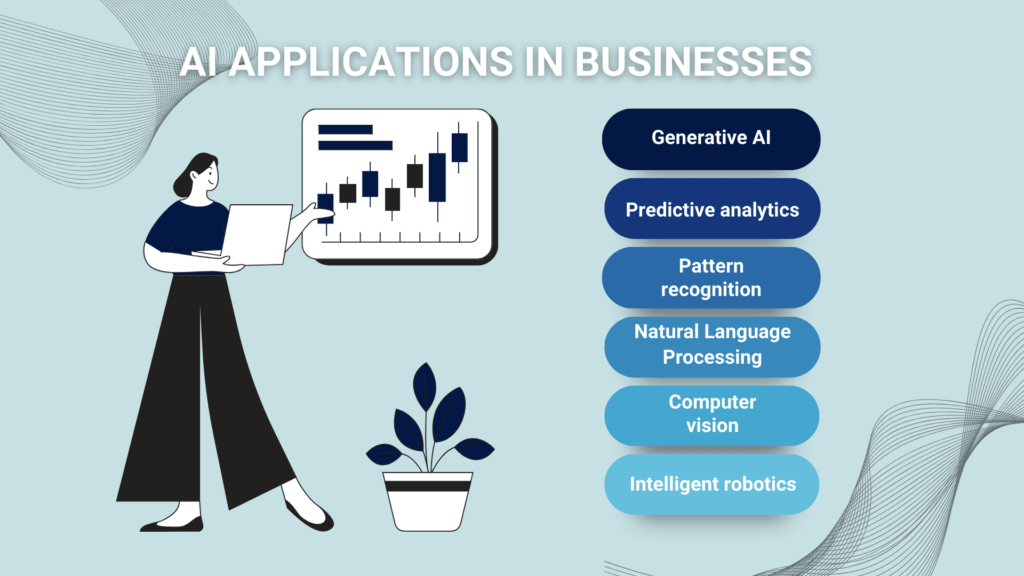
Artificial intelligence can take many forms and be applied across various areas of an organization. Some of the most common applications include:
1. Generative AI: Creates original content (text, images, code, video, etc.) and can be used to automate content generation, design graphic pieces, produce training materials, or train chatbots.
2. Predictive analytics: Enables forecasting of trends or behaviors based on historical data. It’s used in sales, logistics, finance, and marketing.
3. Pattern recognition: Detects anomalies or unusual patterns in real-time. It’s ideal for cybersecurity, predictive maintenance, or fraud detection.
4. Natural Language Processing (NLP): Analyzes, understands, and generates human language. It’s used in customer service, sentiment analysis, and administrative process automation.
5. Computer vision: Allows machines to “see” and interpret images and videos. It’s widely used in manufacturing, healthcare, and retail.
6. Intelligent robotics: AI-powered robots that can interact with their environment and adapt to new situations.
Benefits of Applying Artificial Intelligence in Business
The integration of AI in business not only provides a competitive advantage but also redefines how organizations operate, make decisions, and create value. These benefits span multiple areas and levels:
1. Faster, Data-Driven Decision-Making
One of AI’s main contributions is its ability to process large volumes of data in real time, identifying patterns, correlations, and anomalies often missed by humans. This enables companies to make faster, evidence-based decisions instead of relying solely on intuition or past experience.
2. Process Automation
AI enables the automation of key business tasks, but its impact goes beyond simple task execution. When applied strategically, AI can intervene at critical workflow points to analyze data, generate automatic summaries, enhance decision-making, optimize internal searches, and create personalized reports in real time.
3. Personalized Customer Experience
Thanks to predictive analytics and machine learning models, AI can offer more relevant and tailored user experiences. This includes personalized product recommendations and communications adapted to each customer’s behavior, increasing satisfaction, loyalty, and conversion rates.
4. Process and Resource Optimization
AI can identify inefficiencies in internal processes, suggest improvements, and predict outcomes with greater accuracy. In logistics, for example, it can optimize delivery routes; in manufacturing, predict equipment failures; and in retail, forecast demand levels for better inventory management.
5. Driving Innovation
By freeing up operational time and offering new analytical capabilities, AI becomes a key ally in developing new products, services, and business models. Companies that integrate AI across their operations often accelerate their innovation cycles, reduce time-to-market, and respond more quickly to market needs.
6. Continuous Improvement and Machine Learning
Unlike traditional systems, AI models can learn and improve over time as they are exposed to more data. This allows the creation of solutions that become more accurate and efficient, driving continuous improvement without needing complete redesigns.
7. Risk Reduction and Anomaly Detection
In areas such as finance, cybersecurity, or quality control, AI is used to monitor behavior patterns in real time and detect deviations that could signal fraud, errors, or threats. This helps prevent losses and mitigate risks before they become major issues.
Examples of AI Use in Business
1. Surf Life Saving Queensland (Australia)
Surf Life Saving Queensland (SLSQ) is an organization dedicated to water rescue and safety across 8,000 kilometers of coastline. GeneXus Consulting developed the SLSQ Hub, a platform with AI that automates responses to frequent inquiries and enhances the experience of 34,000 volunteers. It uses natural language processing to provide real-time responses aligned with their safety protocols.
2. Architecture Firm (Uruguay)
For a leading architectural firm, an AI solution was implemented to automate document analysis and classification. Through language models and OCR processing, access to key information was significantly accelerated, improving the team’s decision-making processes.
3. Universidad del Trabajo del Uruguay (UTU)
The “Teaching Aspirations” module at the Universidad del Trabajo del Uruguay (UTU) is a prime example of how AI can optimize academic selection and management processes. GXC developed an AI platform to automate the evaluation of teaching applications. This accelerates processing times, standardizes evaluation criteria, and ensures a more efficient and secure experience for both evaluators and applicants.
Main Challenges to Overcome
Although artificial intelligence offers significant opportunities for businesses, its adoption is not without obstacles. Understanding these challenges is key to outlining a realistic and effective roadmap. Below, we analyze the main critical points:
- Data Quality and Governance
The success of any AI solution depends directly on the quality of the data that feeds it. Many companies struggle to consolidate, clean, and structure their data—especially when it comes from multiple sources or legacy systems. Additionally, the lack of a data governance strategy—including access policies, security, and traceability—can compromise the effectiveness and trustworthiness of AI models. - Shortage of Specialized Talent
Implementing AI requires technical profiles with expertise in data science, machine learning, data engineering, and algorithmic ethics. However, this type of talent is scarce and in high demand, making it difficult to build in-house teams. Companies that lack this expertise should consider strategic partnerships or low-code/no-code platform solutions. - Resistance to Organizational Change
Adopting AI involves modifying processes, roles, and ways of working. This can generate uncertainty or resistance among staff, especially if they feel their jobs are at risk. AI-driven digital transformation must be accompanied by strong change management, training programs, and clear communication about the expected benefits. - Implementation Costs
While AI can generate significant savings and efficiencies in the long run, its initial implementation may require considerable investment. This includes the acquisition of software and hardware, hiring specialists, team training, and data migration or integration. To mitigate this challenge, it is advisable to start with low-risk pilots that allow results to be measured before scaling up. - Ethical and Compliance Risks
The use of AI raises critical issues in terms of privacy, algorithmic bias, explainability, and accountability. It is essential for companies to adopt an ethical-by-design approach, implementing practices such as model audits, the use of representative datasets, and compliance with regulatory frameworks (such as GDPR, HIPAA, or others, depending on the country or sector). - Model Maintenance and Evolution
Once in production, AI models require ongoing monitoring, updates, and adjustments. Changes in data, user behavior, or market conditions can cause the model’s performance to degrade over time (a phenomenon known as model drift). Organizations must allocate resources and processes to ensure operational continuity and technological evolution.
Future Trends of Artificial Intelligence in Business
The future of artificial intelligence in business includes new trends and applications such as:
- Autonomous AI Agents: Systems capable of carrying out complex tasks from start to finish without direct human supervision.
- Multimodal Generative AI: Integration of text, images, audio, and video in a single content generation experience.
- Real-Time AI: Analysis and response generation with near-zero latency—ideal for critical operations.
- Explainable AI: More transparent models that help companies understand how and why certain decisions are made.
- Democratization of AI Access: Low-code/no-code platforms will allow more users to develop solutions without being experts.
Conclusion
Artificial intelligence in business is no longer a promise of the future—it is a present-day reality that is reshaping business models. From improving operational efficiency to transforming the customer experience, its applications are broad and its benefits tangible.
However, to fully harness its potential, it is essential to overcome challenges such as data quality, initial investment, or internal readiness. Those who succeed will be better positioned to compete in an increasingly digital and dynamic environment.
Want to discover how to apply AI in your organization?
Schedule a meeting with Alejandro Cimas, and let’s analyze your first AI success case together.
-
 Previous
The Future of BPM:...
-
Next
AI and Low Code: A...
