


Introduction
Many organizations invest in technology without a clear vision of where they want to go. The problem is usually not a lack of tools, but the absence of a plan that organizes decisions, priorities, and timelines. Without a well-defined technology roadmap, digital transformation becomes reactive, fragmented, and difficult to sustain over the long term.
A poorly designed roadmap can have the same effect as having none at all: projects that are not connected to each other, initiatives that lose impact, and a growing gap between business strategy and technological execution. That is why understanding which mistakes to avoid when building a roadmap is key to ensuring that technology truly drives organizational goals.
What Is a Technology Roadmap and Why Is It Key to Business Strategy?
A technology roadmap is a strategic plan that defines, over time, how an organization will adopt, evolve, or replace technologies to support its business objectives. It is not simply a list of tools or systems, but a structured vision that connects business strategy with the technological capabilities required to execute it.
A strong technology roadmap answers key questions such as:
– What digital capabilities does the business need today, and which will it need in the future?
– Which technologies are critical, and which can wait?
– How should initiatives be prioritized based on impact, cost, and risk?
– What dependencies exist between projects?
From a strategic perspective, a roadmap helps anticipate market changes, reduce improvisation, and enable informed decision-making. It also facilitates communication between technical and business teams—essential to preventing technology from becoming an end in itself.
What Is a Technology Roadmap Used for in a Digital Transformation Process?
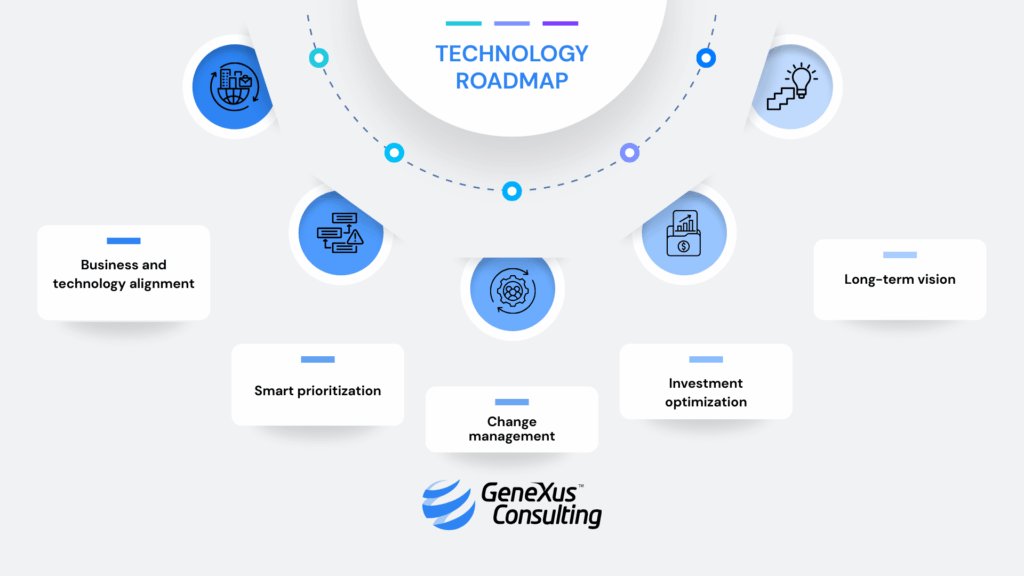
In a digital transformation process, the technology roadmap serves multiple purposes:
– Business and technology alignment: ensures that every technological initiative has a clear purpose and is tied to strategic objectives.
– Smart prioritization: helps determine which projects to address first and which to postpone, avoiding resource dispersion.
– Change management: enables a gradual approach to technology adoption, taking into account people, processes, and organizational culture.
– Investment optimization: reduces the risk of investing in solutions that later fail to integrate or deliver value.
– Long-term vision: provides clarity on the path forward, even in changing environments.
In this context, emerging technologies such as artificial intelligence in business play an increasingly important role, but their adoption must be guided by a clear strategy—not by trends or external pressure.
The Most Common Mistakes When Creating a Technology Roadmap
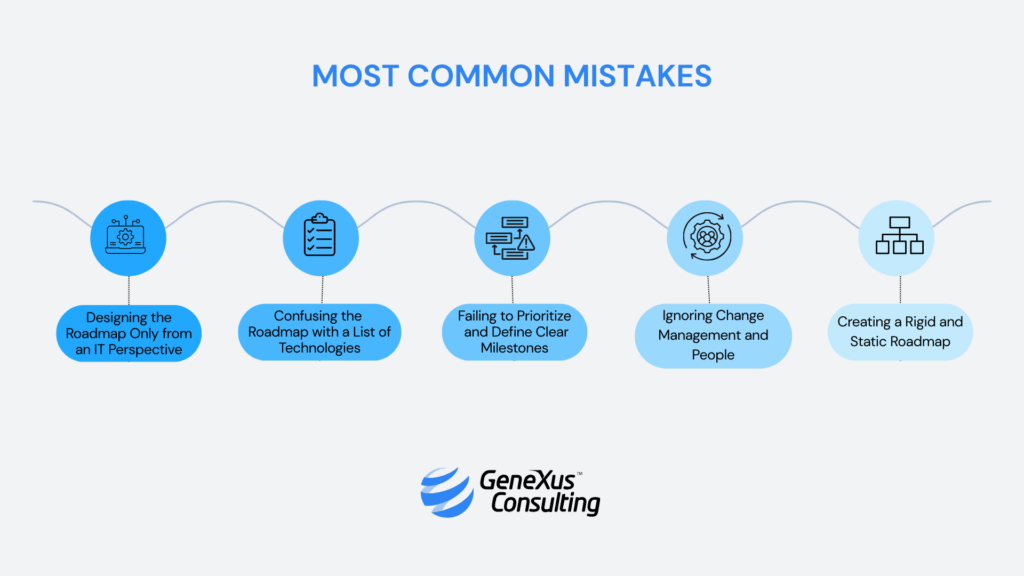
Despite its importance, many organizations make recurring mistakes when designing their technology roadmap. These are the most common ones.
Mistake 1: Designing the Roadmap Only from an IT Perspective
One of the most common mistakes is having the technology roadmap defined exclusively by the IT department, without active involvement from the business. This often results in technically sound plans that are disconnected from the organization’s real needs.
How to avoid it: the roadmap should be built collaboratively, involving business leaders, operations, finance, and technology teams. The key is to start with strategic objectives and then define how technology enables them.
Mistake 2: Confusing the Roadmap with a List of Technologies
Another frequent mistake is reducing the roadmap to an inventory of tools, platforms, or systems to be implemented. This turns the roadmap into a rigid, low-value document with little strategic focus.
How to avoid it: the focus should be on the capabilities the organization needs to develop (automation, advanced analytics, interoperability, scalability, etc.), rather than on specific technologies alone. Tools may change; strategic capabilities do not.
Mistake 3: Failing to Prioritize and Define Clear Milestones
A roadmap without clear priorities often becomes an endless list of initiatives that never materialize. The lack of milestones and prioritization criteria leads to frustration and loss of focus.
How to avoid it: it is essential to define objective prioritization criteria, such as business impact, urgency, complexity, and expected return. In addition, setting measurable milestones allows progress tracking and course correction when necessary.
Mistake 4: Ignoring Change Management and People
Technology roadmaps often focus solely on systems and processes, overlooking the people who will need to adopt these new technologies. This mistake is one of the main causes of failure in digital transformation initiatives.
How to avoid it: the roadmap should include training, communication, and change support initiatives. Technology adoption is not just a technical challenge—it is primarily a cultural one.
Mistake 5: Creating a Rigid and Static Roadmap
In dynamic environments, an overly rigid roadmap quickly becomes outdated. Organizations that fail to review and adjust their roadmap risk becoming misaligned with new opportunities or threats.
How to avoid it: the technology roadmap should be a living document, reviewed on a regular basis. Flexibility and adaptability are essential to sustaining strategy over time.
The Technology Roadmap as a Driver of Sustainable Digital Transformation
Sustainable digital transformation is not achieved through isolated initiatives or impulsive decisions. It requires a long-term vision, strategic coherence, and disciplined execution. In this sense, the technology roadmap acts as a true engine of change.
With a well-designed roadmap, organizations can:
– Scale digital capabilities in an orderly way.
– Integrate new technologies without generating unnecessary technical debt.
– Measure the real impact of technology on business results.
– Adapt to new regulations, markets, or business models.
At GeneXus Consulting, we support organizations in the design and evolution of their technology roadmap by combining strategic vision, business knowledge, and experience in digital transformation projects. Our approach ensures that technology becomes a true enabler of growth and competitiveness.
Conclusion
Designing a technology roadmap is not a theoretical exercise or a document to be archived. It is a strategic tool that defines how an organization transforms, innovates, and competes over time. Avoiding common mistakes—such as lack of business alignment, absence of prioritization, or rigidity—is essential for the roadmap to fulfill its purpose.
If your organization is undergoing or planning a change process, having a well-structured technology roadmap can make the difference between an improvised digital transformation and a truly sustainable one.
We invite you to explore our Digital Transformation services and discover how GeneXus Consulting can support you on this journey.
-
 Previous
¿Cómo medir la m...
-
Next
Signs Your Softwar...
