


TL;DR
- Legacy system migrations keep getting postponed because of scattered knowledge, unclear dependencies and a scope that is hard to estimate.
- A system of coordinated AI agents covers the entire cycle in four stages: strategy, specification, implementation and activation, with human validation at every decision point.
- AI makes progressive, capability-by-capability modernization viable without disrupting business continuity.
- This approach achieves up to 90% first-try acceptance and up to 40% less effort, while the system’s knowledge is recovered and documented.
Many organizations run on systems that have been in production for 20 years or more. They support business-critical processes, but over time the knowledge of how they work has become concentrated in a few people, or has left the company along with them. That is why the need to modernize legacy systems with AI has become a priority.
Legacy system modernization has always been a hard project to justify: uncertain scope, an investment that is difficult to commit to, and the risk of disrupting operations. Artificial intelligence is changing that equation.
In this webinar (in Spanish), Diego de Fuentes, CTO of GeneXus Consulting, explains how a system of coordinated agents can integrate the entire modernization cycle: understanding the existing software, recovering knowledge, proposing alternatives, implementing changes and evaluating the results in every iteration.
Why migrations get postponed
In legacy systems, internal dependencies and external integrations become increasingly blurred. Without the full context, every change is made with extra safeguards in the code, which in turn make it even harder to understand. It’s a snowball effect: every evolution costs more than the last one.
On top of that, the project is hard to size. Without precise knowledge of the system, the scope tends to be overestimated to cover risks, or it falls short. Meanwhile, the system keeps running, which makes the need for change harder to see.
What modernizing a system really means
Modernizing is not just about keeping the system running on a different technology. It’s about using the migration to add value on four fronts:
Platform. Which infrastructure and runtime environments the solution will move to.
Implementation. Which languages to use and how to reorganize the code internally.
Architecture. How to break down a monolith with years of accumulated features: which components to define, what their boundaries will be and which architecture to aim for.
Business rules. Identifying which rules are still valid for today’s business and which have become obsolete inside the legacy system.
Why modernize now
Beyond the usual reasons, such as staying technically current, running supported versions and being able to apply patches, there are now three more:
- Integration and agent readiness. Applications will increasingly connect through AI agents, and they need to be ready for that kind of interaction.
- Ability to evolve. A modernized system makes it possible to add new features with far less complexity and cost.
- Security. AI also empowers attackers, who can now exploit application vulnerabilities faster and at greater scale, especially in outdated systems. Learn more about our Cybersecurity Services.
Two strategies: full cutover or progressive modernization
The traditional approach is to migrate the whole system (or a module), do a cutover and go live with the new system. The alternative is progressive, capability-by-capability modernization: facades are designed to route each new feature to the target system while the legacy system is gradually switched off.
Progressive modernization has always been a sound approach, but it came at a high cost: designing the facades, the coexistence of both systems and the dependencies between them. With AI agents, that path becomes much simpler and requires less effort. Learn more about our Technological Evolution services.
How to modernize legacy systems with AI: the agent-based process
The process is organized in four stages, each supported by specialized agents and with human validation (human in the loop) at every decision point.
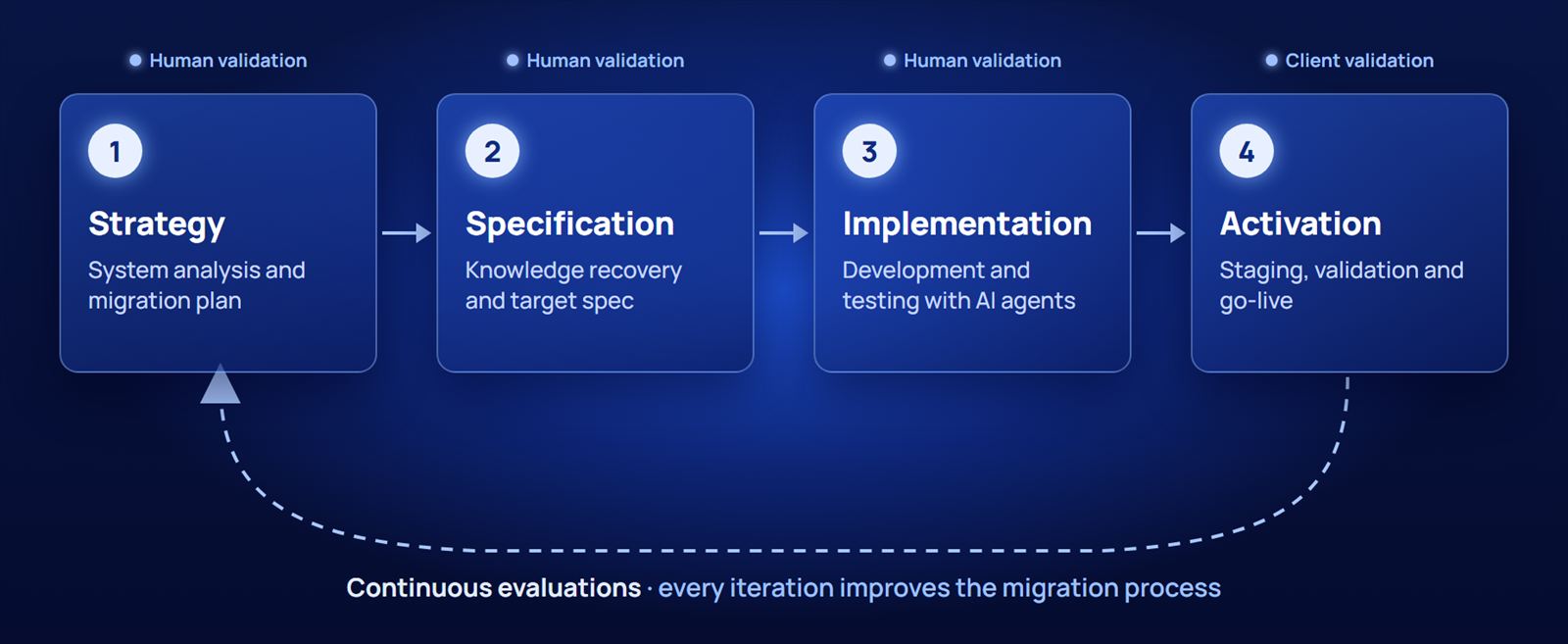
Stage 1
Strategy
An agent analyzes the source system: structure, code quality, data and dependencies. A transition agent proposes a migration plan, and an auditor agent checks that it meets the defined risk, effort and value conditions. The result is a strategic plan refined together with the client.
Stage 2
Specification
For each stage of the plan, a knowledge agent recovers the rules and behavior of the current system, and a redesign agent builds the target specification based on the agreed architecture and technology. A validation layer checks its quality before approval.
Stage 3
Implementation
GeneXus Consulting’s AI-driven development cycle breaks the work into user stories, carries out the development and runs the tests. Evaluations (evals) don’t just verify each feature: they measure how the migration process itself is performing, so it can be improved.
Stage 4
Activation
Validated features move to staging for client validation and, from there, to production. All the accumulated knowledge makes it possible to plan the rollout with greater precision.
An example: modernizing the collections module
Given the goal of modernizing collections, the strategy agent compares two options: migrating the entire module or replacing it capability by capability, with a report on the pros and cons of each. If the progressive path is chosen, the first step might be to migrate only the debt inquiry feature, while everything else keeps running on the legacy system.
The agents recover the rules, specify how the new inquiry should work and define the coexistence plan between both systems. Then the balance calculation is implemented, the tests are built and the artifact is ready in staging for validation. Once it’s accepted, the team moves on to the next capability.
Migration as a continuous improvement project
A migration project should be treated as a project to continuously improve the migration process itself.
Every system is different: one with dead code is not the same as one where all the code is active, and one built on standards is not the same as one that grew through developments with no common criteria. The process has to adapt to that reality, and to do so it measures four dimensions:
- Quality: how many units are accepted on the first try and how many iterations the rest require.
- Human effort: how many hours people spent correcting and completing the agents’ work.
- Consumption: number of executions and token usage, an increasingly relevant factor.
- Continuity: defects and regressions detected after go-live.
Results
70% → 90%
first-try acceptance, as the process adapts to each client
Up to 40%
less total effort across the migration project
Fewer tokens
thanks to the adjustments made after each process evaluation
Unlike earlier approaches focused on speeding up development and testing, the improvement now covers the entire discipline: planning, specification, development and testing. This also shortens the time to market of the solutions.
What remains after the migration
Beyond the modernized system, the organization gains assets it probably didn’t have before:
- Recovered knowledge: business rules, dependencies and data, documented and traceable.
- Specifications for every feature.
- A set of reusable tests, which serves as evidence of acceptance and as protection against regressions.
- Code and documentation: technical documentation, user manuals and in-code comments.
All of this becomes the starting point for evolving the system with an AI-based development cycle of its own.
FAQ: how to modernize legacy systems with AI
What about data security?
The approach is agnostic to the AI model used. Only code is sent to the agents, never business data, and the contracts with model providers ensure the information is not stored or used for training.
Is security testing included?
Yes. The programming agent works with security criteria it must meet, and the testing agent verifies that they are met.
What if the legacy code has no documentation or good practices?
A code analysis and review agent first assesses the quality of the solution and its patterns. That diagnosis is the input for the agents that recover the knowledge and design the target system.
Can an old GeneXus version be migrated to the latest one?
Yes, and it’s one of the most common scenarios today. GeneXus Consulting has its own tools for migrating and re-expressing GeneXus knowledge bases, which improve both understanding of the KB and token usage.
Does the migration always target GeneXus?
No. It’s possible to migrate from GeneXus to GeneXus, to a different front end or to another technology, using reverse spec agents. For critical core systems, such as an ERP, moving away from GeneXus should be evaluated carefully; for features that are peripheral to the operation, any of these options is viable.
How is token usage kept under control in very large systems?
Through proprietary models and representation methods that build intermediate knowledge layers, avoiding the need to process all the code directly.
Conclusion
When you modernize legacy systems with AI, you don’t just speed up the migration: you transform the way it’s approached. AI makes progressive modernization viable, reduces effort at every stage and leaves the organization with its knowledge recovered and documented. The more knowledge and iterations the process receives, the better the quality and speed of each migration.
To start to modernize legacy systems with AI, the recommendation is to take a well-defined portion of the system, such as a module or a single feature, measure the results and, from there, expand the scope based on concrete evidence.
Next step
Want to assess the migration of your system? Let’s start with a pilot module and measure the results together.
-
Next
¿Cómo medir la m...
